

President Ruto on Monday morning assented to three key Bills aimed at strengthening Kenya’s position as an attractive investment destination by creating a more efficient, predictable, and competitive business environment.
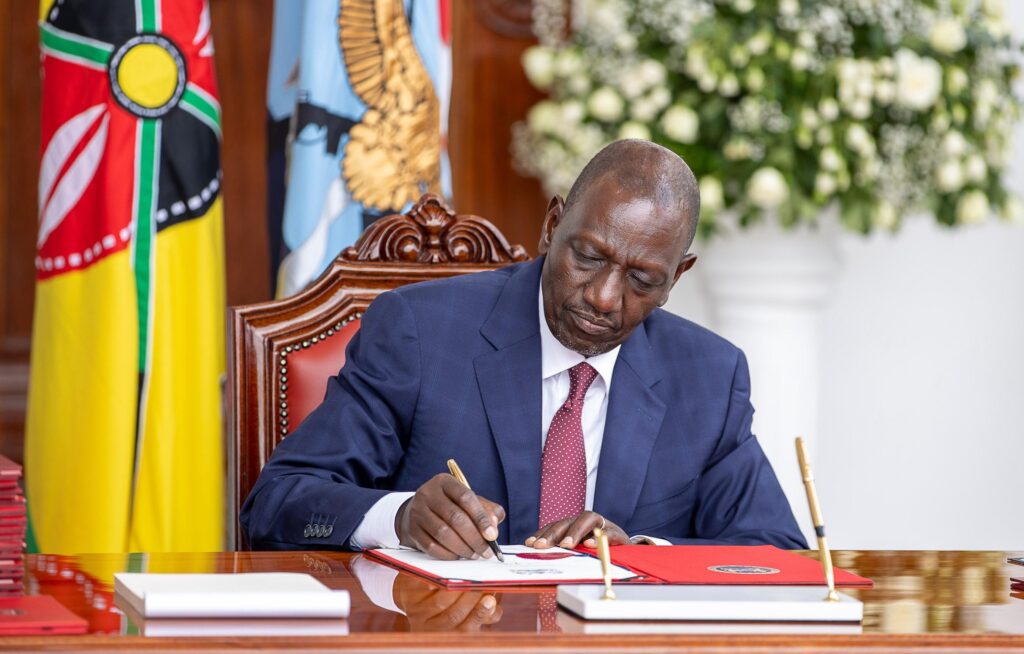
Ruto signed into law the Income Tax Bill, the Special Economic Zones (Amendment) Bill, and the Technopolis Bill, during a ceremony held at State House, Nairobi on Monday May 11, 2026.
The Income Tax (Amendment) Bill, sponsored by Molo Member of Parliament Kuria Kimani, will ease how companies reorganise ownership structures and move assets within corporate groups without triggering tax penalties.
The new legislation also exempts companies and shareholders from paying capital gains tax on property transfers carried out as part of internal restructuring, provided ownership proportions remain unchanged.
In a statement issued after the assenting ceremony, President Ruto said the bill “seeks to rationalise the administration of Capital Gains Tax and align Kenya’s tax regime with international best practice and principles of taxation, while reinforcing the gains made in improving the ease of doing business.”
The proposed tax changes are expected to take effect in the 2026/27 financial year beginning July 1, 2026.
At the same time, President Ruto also signed the Special Economic Zones (Amendment) Act, which seeks to boost Kenya’s competitiveness by expanding the scope of special economic zones to include oil and gas activities, while also harmonising tax incentives for entities operating within the zones.
The law strengthens the special economic zones framework by aligning it with the operational realities of large-scale capital investments, through the provision of a minimum licence tenure of 10 years to accommodate long project cycles.
According to Ruto, “the legislation will expand the scope of special economic zones to support strategic sectors of the economy, including agro-processing, manufacturing, mining, advanced technology production, and petroleum operations.”
The Technopolis Act provides a comprehensive framework to guide the creation, governance, and growth of technopolises across Kenya.
The law seeks to position Kenya as a leading destination for technology-driven enterprises, innovation, and research by establishing integrated one-stop hubs for the efficient delivery of government services.
The framework is expected to attract global investment, talent, and innovation while accelerating Kenya’s transition into a knowledge-based digital economy.
Deputy President Kithure Kindiki, ICT Cabinet Secretary William Kabogo, Attorney General Dorcas Oduor, National Assembly Speaker Moses Wetang’ula, National Assembly Majority Leader Kimani Ichung’wah and Minority Leader Junet Mohamed attended the signing ceremony among other senior government officials.
