

President William Ruto has unveiled a wide-ranging economic package after signing the Finance Bill, 2026, into law, announcing a significant increase in the duty-free allowance for returning travellers while defending the new legislation as a measure designed to promote fairness, create jobs and accelerate national development.
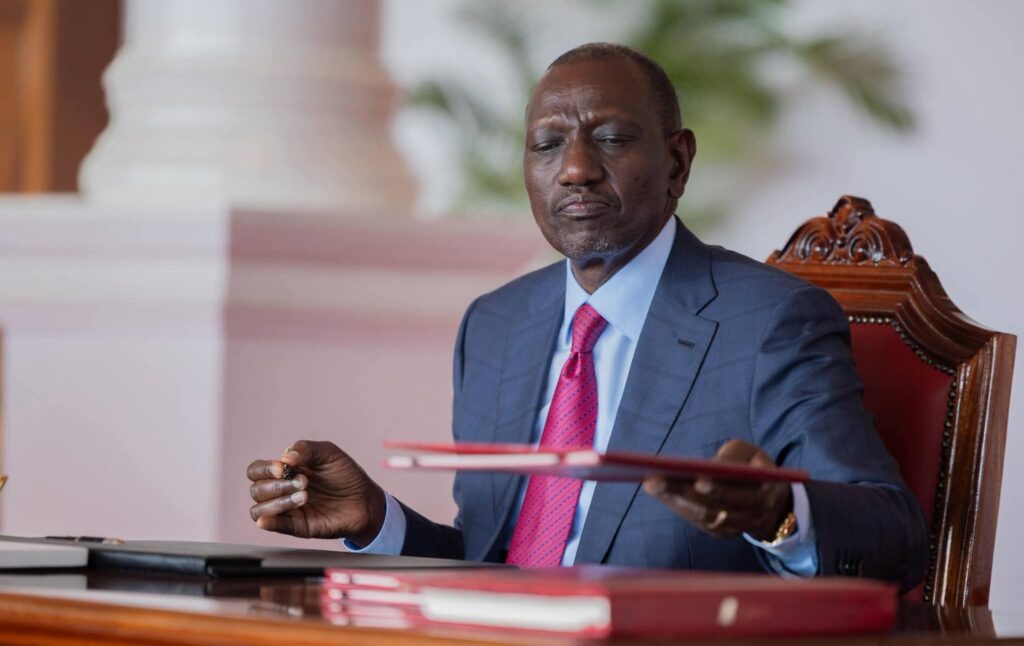
The President said Kenyans returning from abroad, including members of the diaspora, will now be allowed to bring in gifts and personal belongings worth up to Ksh.260,000 without paying import duty, a sharp rise from the previous Ksh.39,000 threshold.
He said the change responds to concerns raised by travellers who have long argued that the existing limit was too restrictive.
“To address concerns raised by returning travellers, including Kenyans who travel abroad and members of the diaspora, we have increased the duty-free allowance from Ksh.39,000 to Ksh.260,000 for gifts and personal effects that Kenyans can buy as they travel or as they come home from their jobs abroad,” Ruto said.
The announcement came as the Head of State also assented to the Appropriation Bill and the Supplementary Appropriation Act, 2026, saying the three laws provide the financial and legal framework needed to drive the government’s Bottom-Up Economic Transformation Agenda.
Addressing criticism surrounding the Finance Act, Ruto maintained that the law does not introduce additional taxes targeting ordinary Kenyans but instead focuses on improving tax compliance and sealing revenue leakages.
“We are pursuing tax avoidance, not taxpayers; offshore schemes, not ordinary wages; and leakages, not livelihoods,” he said.
The President dismissed claims that the legislation introduces taxes on freehold land, second-hand clothing, rental income, bottled water, M-Pesa transactions, mobile phones, airtime, data or locally manufactured packaging, urging Kenyans to reject misinformation.
“Together, we must reject propaganda, misinformation, disinformation, fake news, insults, hate, ethnic bigotry and profiling, and division,” he said.
Among the measures announced are incentives aimed at supporting local manufacturing and green transport, including tax benefits for motorcycles, electric buses, bicycles, solar batteries and locally assembled mobile phones.
The government has also increased duty on imported sugar from Ksh.7.50 to Ksh.40 per kilogram, saying the move will protect local factories and millions of livelihoods tied to the sugar industry.
Taxpayers with outstanding obligations will benefit from a six-month amnesty that waives penalties and interest, while mortgage-related tax relief has been expanded to include borrowers accessing financing through microfinance institutions.
Ruto also outlined major spending priorities under the new budget, with education receiving Ksh.784 billion, health Ksh.175.5 billion and agriculture Ksh.63 billion. The government plans to employ 20,000 teachers on permanent and pensionable terms and recruit another 24,000, bringing the total number hired during his administration to 124,000.
Higher education funding has also been boosted through increased allocations to HELB and scholarship programmes for universities, KMTC and TVET institutions. An additional Ksh.3 billion will support school feeding programmes benefiting 2.8 million vulnerable learners, while Ksh.15 billion has been earmarked for classrooms, laboratories and STEM education.
In the health sector, the President announced Ksh.19.1 billion for primary healthcare, saying registered members of the Social Health Authority will access outpatient services at accredited public, private and faith-based facilities without paying.
“As a result, no Kenyan should pay for outpatient services at dispensaries, health centres and sub-county health facilities in SHA-accredited public, private or faith-based hospitals,” he said.
Funding for KEMSA has also risen to Ksh.21 billion to improve the supply of medicines across the country.
Agriculture remains another key focus, with Ksh.20 billion allocated for seed and fertiliser subsidies, helping maintain fertiliser prices at Ksh.2,500 per bag.
Additional funding has been set aside for food resilience, sugar sector support, coffee debt waivers, youth farming credit and programmes targeting pastoralist communities.
The government has further committed Ksh.110 billion to programmes supporting women, youth and vulnerable groups, including Ksh.22.6 billion for youth initiatives, Ksh.12.4 billion for the National Youth Service, Ksh.8.8 billion for affordable credit and Ksh.25 billion for cash transfers benefiting 1.2 million households.
The Judiciary will receive Ksh.30 billion to strengthen access to justice, while Ksh.138 billion has been allocated for affordable housing and urban development.
Infrastructure projects will receive substantial funding, including Ksh.225 billion for roads, Ksh.52 billion for transport infrastructure and Ksh.20.8 billion for the extension of the Standard Gauge Railway from Naivasha to Kisumu and Malaba.
To cushion consumers from fluctuating fuel costs, Ksh.21.5 billion has been allocated for fuel stabilisation, while Ksh.10.5 billion will support digital connectivity and the expansion of government services online.
Water, sanitation and environmental projects have been allocated Ksh.112.4 billion, with Ksh.9.4 billion set aside to address historical land challenges at the Coast.
The blue economy will benefit from investments in fish landing sites, rescue centres and ferry services, while Ksh.26.4 billion has been committed to sports infrastructure, preparations for AFCON 2027 and support for Kenyan athletes competing internationally.
Expressing confidence in the country’s economic direction, Ruto said the government’s focus remains on inclusive growth and long-term prosperity.
“This is what a fair tax system looks like: One that protects the vulnerable, rewards enterprise, promotes compliance and shares responsibility fairly,” he said.
“The ultimate measure of this Budget will be the opportunities it creates and the lives it transforms,” said President Ruto.
