

Kenya and France have strengthened their diplomatic and economic ties after signing 11 cooperation agreements covering transport, energy, technology, trade and education.
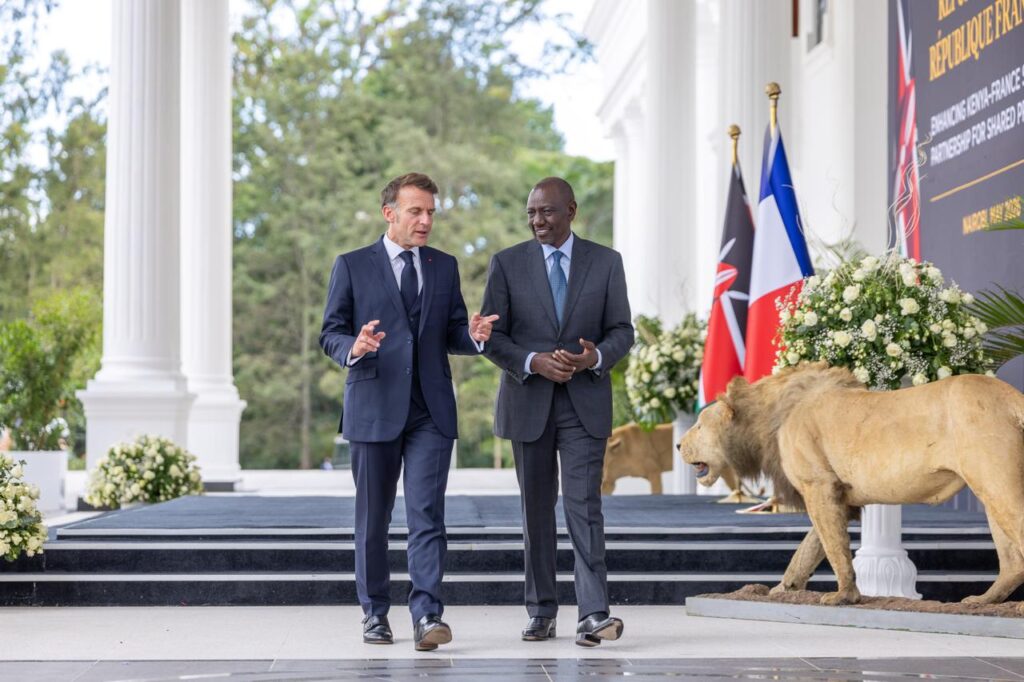
The deals were signed at the State House in Nairobi during a meeting between President William Ruto and French President Emmanuel Macron, who is in the country for the Africa Forward Summit.
Among the key projects announced is the planned upgrade of the Nairobi commuter railway system, a project estimated to cost Ksh.12.5 billion.
The rail improvement programme is expected to ease movement between Nairobi and surrounding towns such as Syokimau, Embakasi, Ruiru and Kikuyu.
“New extensions, including the Riruta-Ngong line currently under construction, will further improve connectivity across the metropolitan area,” President Ruto said.
The two governments also entered into an agreement to jointly develop logistics and port infrastructure in a project valued at about Ksh.104 billion, signalling growing cooperation in trade and regional transport.
In the agriculture sector, Kenya is seeking to expand access for its speciality tea products in the French market.
The agreement includes promotion of premium purple tea varieties with the aim of increasing earnings for local farmers through value addition.
Digital development also featured prominently in the discussions, with both countries agreeing to work together in areas such as cyber security, artificial intelligence, digital public services and data systems.
“Kenya is building a dynamic digital economy that is driving innovation, competitiveness, and regional integration through flagship initiatives such as Konza Technopolis and the Digital Superhighway,” President Ruto said.
Kenya is also looking to tap into French expertise in nuclear energy as the country works toward increasing electricity generation capacity.
“Kenya is going to benefit from France’s understanding of nuclear energy,” he added.
Additional agreements touched on climate and weather services, fisheries, sustainable aviation fuel production and the expansion of the Kipeto Wind Energy Project, which is expected to add 100 megawatts of power at a cost of Ksh.32.5 billion.
The leaders further discussed improving direct air links between Kenya and France to support tourism, trade and investment opportunities.
“At present, limitations in frequency, capacity, and routing constrain the full potential of direct air links between our two countries,” President Ruto noted.
On healthcare, Kenya and France agreed to strengthen collaboration in digital health systems, laboratory services and epidemic preparedness to improve early response to future disease outbreaks.
In education, implementation of the University of Nairobi Engineering and Science Complex project valued at Ksh.5.6 billion is expected to begin soon.
The two presidents also used the meeting to push for stronger Africa-France relations and reforms to global financial systems to improve access to funding for developing nations.
“President Macron and I agreed that the Africa-France Summit must move beyond dialogue to implementation, with a clear focus on investment, innovation, and partnerships that deliver measurable results,” President Ruto said.
He described Kenya’s hosting of the summit as historic, noting it is the first time in more than five decades that the meeting is being held outside a Francophone country.
“Kenya is deeply honoured to host this summit, the first to be held outside France or a Francophone African country in more than five decades,” he said.
President Ruto maintained that Kenya’s approach to foreign relations is guided by development and practical partnerships.
President Macron said France intends to expand investment and cooperation across Africa, adding that reforms to the continent’s financial systems would be among the key issues discussed during the summit.
“We will try and speed up the reform of the African Financial Infrastructure with the African Development Bank,” President Macron said.
He also dismissed suggestions that holding the summit in Kenya sidelines West African nations, saying leaders from the region would still participate in the discussions.
