

Fighting between the United States and Iran has flared up again, barely a month after both countries signed an agreement aimed at easing tensions in the Middle East.
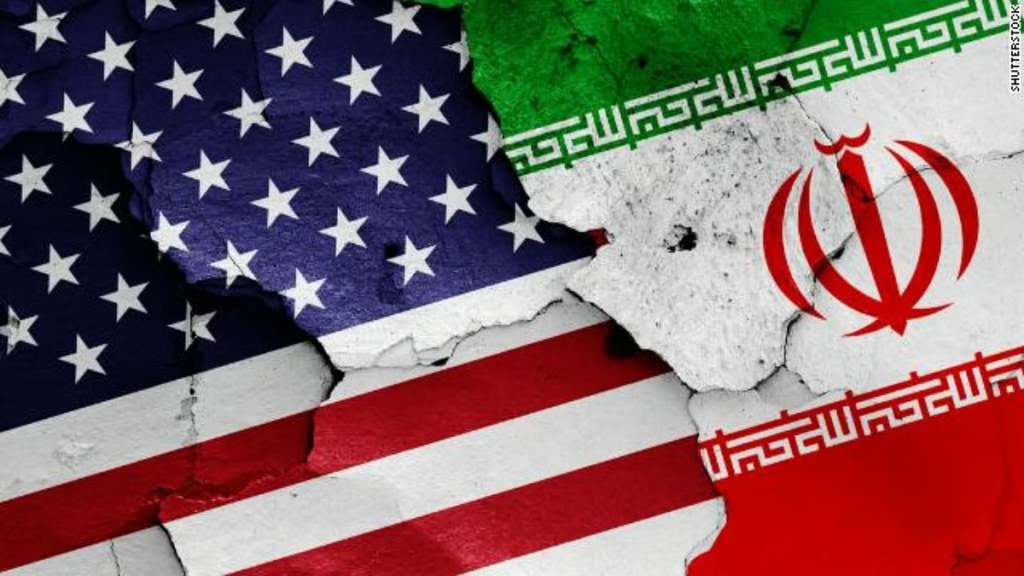
The renewed confrontation has seen military action intensify across the region, raising fresh concerns over regional stability and the security of global energy supplies.
The latest escalation began after the United States launched airstrikes on several Iranian targets while reinstating a naval blockade.
According to the US Central Command, the operation was intended to weaken military capabilities that Washington says Iran has used to threaten commercial shipping in the Strait of Hormuz, one of the world’s most important oil transit routes.
Iran responded by launching attacks targeting the US Fifth Fleet in Bahrain.
Military authorities there said the attacks were intercepted before reaching civilian areas, while Jordan’s armed forces reported destroying three Iranian missiles that entered its airspace.
US President Donald Trump warned that military operations could expand if Tehran fails to return to negotiations.
“Next week it gets really bad for them,” Trump told Fox News.
Although fighting has resumed, diplomatic efforts between the two countries have not officially collapsed.
The Strait of Hormuz remains at the centre of the dispute. Iran had previously blocked the waterway after hostilities erupted earlier this year before briefly reopening it following last month’s agreement.
Tehran has now declared the route will remain closed until what it describes as US aggression comes to an end. In response, Washington has restored restrictions on Iranian ports, although Trump withdrew an earlier proposal to impose a 20 percent levy on ships using the strategic waterway.
Iranian Deputy Foreign Minister Kazem Gharibabadi said the renewed US measures has, in a way, dismantled the Islamabad memorandum referring to the agreement signed last month.
Iranian state media reported explosions near Bandar Abbas, Qeshm Island, Bandar Imam Khomeini and Bushehr, where the country’s only civilian nuclear power plant is located.
The military also confirmed that seven service members were killed during Wednesday’s attacks, while government officials said at least 30 people have died since the latest round of US strikes began last week.
Away from the battlefield, civilians are increasingly bearing the emotional burden of the conflict.
In Qasr-e Shirin, artisan Khadijeh described the fear gripping families living near affected areas.
“The little children are so frightened by the sound of explosions that they don’t sleep until morning. The effects of war will stay in our lives and minds and mental health for a long time. If, God forbid, the war becomes more intense, then perhaps it will take several generations before we can get back on our feet,” said Khadijeh.
Similar concerns have spread across neighbouring Gulf countries. Mustafa Mohamed, a Sudanese accountant living in Kuwait, said uncertainty has become part of daily life.
“Every day, I wake up wondering whether the situation will de-escalate or worsen. It has become difficult to feel at ease or plan anything because uncertainty grips everyone,” he said .
The conflict has also affected international shipping. A Norwegian oil tanker was damaged by an explosion off the coast of Oman, while Kuwait reported that one of its naval vessels was struck during an Iranian missile and drone attack, leaving four crew members injured.
Israel, which has not rejoined the conflict, has nevertheless warned Tehran against expanding the fighting.
Speaking from Dimona, Prime Minister Benjamin Netanyahu cautioned Iran .
“Do not count on things remaining quiet if you attack us,” he said.
As military operations continue and diplomatic efforts struggle to regain momentum, fears are growing that the renewed confrontation could destabilise the wider Middle East, disrupt global trade through the Strait of Hormuz and make prospects for a lasting peace even more uncertain.
