

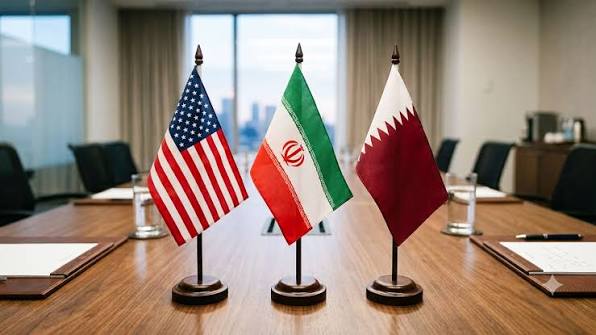
Indirect negotiations between the United States and Iran resumed in Doha on Wednesday as both countries sought to advance efforts aimed at easing tensions and implementing a memorandum of understanding reached after months of conflict.
The talks came against the backdrop of recent military exchanges, although both sides have signalled a willingness to continue diplomatic engagement.
Speaking before departing Qatar aboard the Air Force One aircraft gifted by the Gulf nation, US President Donald Trump expressed optimism about the discussions, saying progress had been made despite earlier disagreements over how the negotiations would be conducted.
“As far as things are going, the denuclearisation of Iran is moving along well,” Trump told reporters.
“We hit them very hard… but we’re getting along very well,”he added.
The negotiations are centred on implementing the memorandum of understanding brokered by Qatar and Pakistan, which was finalised during a summit in Lucerne, Switzerland, last month.
The agreement outlines a 60-day ceasefire, the reopening of the Strait of Hormuz, and a roadmap toward a lasting settlement of the conflict, including discussions on Iran’s nuclear programme.
Although President Trump had earlier suggested the two sides would hold direct talks, Tehran maintained that no face-to-face negotiations with American officials were planned. Iranian Foreign Ministry spokesperson Esmaeil Baqaei said Deputy Foreign Minister Kazem Gharibabadi was leading Iran’s delegation but insisted the officials.
“Have no plans for negotiations with the American side at any level over the coming days”, he said.
Diplomatic sources familiar with the process said discussions in Doha were being conducted through Qatari and Pakistani mediators at a technical level, focusing on implementing the provisions of the agreement reached in Switzerland.
The sources said the talks were intended to build on the progress already achieved.
US envoys Jared Kushner and Steve Witkoff were not part of the technical discussions, although they met Qatar’s Prime Minister Sheikh Mohammed bin Abdulrahman Al Thani on Tuesday to review the status of the negotiations.
Qatar also confirmed that the two American officials later met Emir Sheikh Tamim bin Hamad Al Thani.
Analysts say the continuation of dialogue is an encouraging sign despite conflicting public statements from Washington and Tehran.
“Very early in the negotiation process and battles are being fought privately and publicly,” said Anna Jacob, a non-resident fellow at the Arab Gulf States Institute.
“The overall positive message is that they are continuing to engage after the clashes last week,” she added.
HA Hellyer of the Royal United Services Institute said differing public messages from both governments had created uncertainty around the process, describing the negotiations as lacking transparency.
The talks follow weeks of heightened tensions after Iran and the United States exchanged military strikes in the Gulf.
Tehran targeted a commercial vessel in the Strait of Hormuz, accusing it of violating its approved route, prompting US Central Command to launch attacks on Iranian military positions.
Iran later responded by striking US military facilities in Kuwait and Bahrain, actions condemned by both countries.
Iranian chief negotiator Mohammad Bagher Ghalibaf acknowledged that implementing the agreement would not be straightforward.
“When a war of this magnitude comes to an end… it is inevitable that there will be implementation challenges, incidents and differences of opinion, especially where parties such as the Israeli regime are concerned”, Mohammed said.
He maintained that Iran remained committed to implementing the agreement and expected the United States and its allies to honour their obligations as well.
Hostilities have eased in recent days, including along the Lebanon front, where fighting between Israel and the Iran-backed Hezbollah movement has largely subsided.
Tehran has continued to insist that any lasting agreement should also address the conflict in Lebanon and include the withdrawal of Israeli forces from areas they continue to occupy.
As negotiations continue in Doha, diplomats hope sustained dialogue will help preserve the fragile calm and pave the way for a broader and more durable regional settlement.
